4 min read
"Independent Development Diary 11: Why Do 90% of Independent Development Projects Fail?"


Personal Life
Recently, I've been under a lot of pressure every day, mainly because the project progress hasn't been very smooth; I'll elaborate on this later. Another reason is that I have Thai homework every day, and I don't understand about 70% of the words in the assignments. Of course, this is related to my lack of proper review. I need to learn around 400 words a month, totaling over 1,200 words in three months. To be honest, I really can't remember them because I've spent most of my time on projects in the past few months.
One of the happier things recently is that I finally found a coffee shop that isn't cold. In Bangkok, over 90% of the air conditioning is set very low, and most locals bring an extra piece of clothing. We foreigners basically freeze in short sleeves. So, finding a coffee shop to work in that isn't cold has been a real headache. I don't work from home more than two days a week; although I have everything at home, staying there for long periods isn't good. Everyone should have felt this during the pandemic. Plus, my cat keeps coming over to step on my keyboard, wanting me to play with him, so my work efficiency at home is sometimes lower than in other places.
In the past couple of days, I've been inundated with the Claude Code leaderboard, and we briefly discussed it in a group. According to my judgment, the maximum usage limit is $800 a day, so a monthly total of over $50,000 clearly doesn't align with intuition. I got criticized for this and was shown a video of a big shot who independently developed a product with annual revenue in the tens of millions. My view is that the economic downturn needs to be mythologized, but I don't know how much the course can sell for later.
Later, I thought about the purpose behind this situation. After my unprofessional judgment, it seems they want to gain traction on Twitter. Sure enough, they gained more followers in one day than I have accumulated over a long time. Complaining aside, there are still many aspects of traffic that can be learned from.
Recently, the subscription application for Stripe's Alipay came through, so the projects I work on next should consider a subscription model.
StickerAI
I initially wanted to simplify the quick generation process further, but after working on it for a long time, Claude Code generated a bunch of code with bugs I couldn't find, so I ended up rolling back. Although Claude Code is very useful, I still haven't organized a good workflow for complex projects, so I'm currently very frustrated, repeatedly rolling back code.
Recently, I updated a version that allows for more detailed analytics data because previously I could only see visitors. Later, I wanted to analyze where users were dropping off, so I added some tracking points.
Additionally, I recently saw a big shot launch a product similar to a racing track. How should I put it? When it first launched, I even made some stickers for the big shot and tagged them, but they didn't share it. Now they've launched a similar product, which just shows how the free market works.
PromptPlan
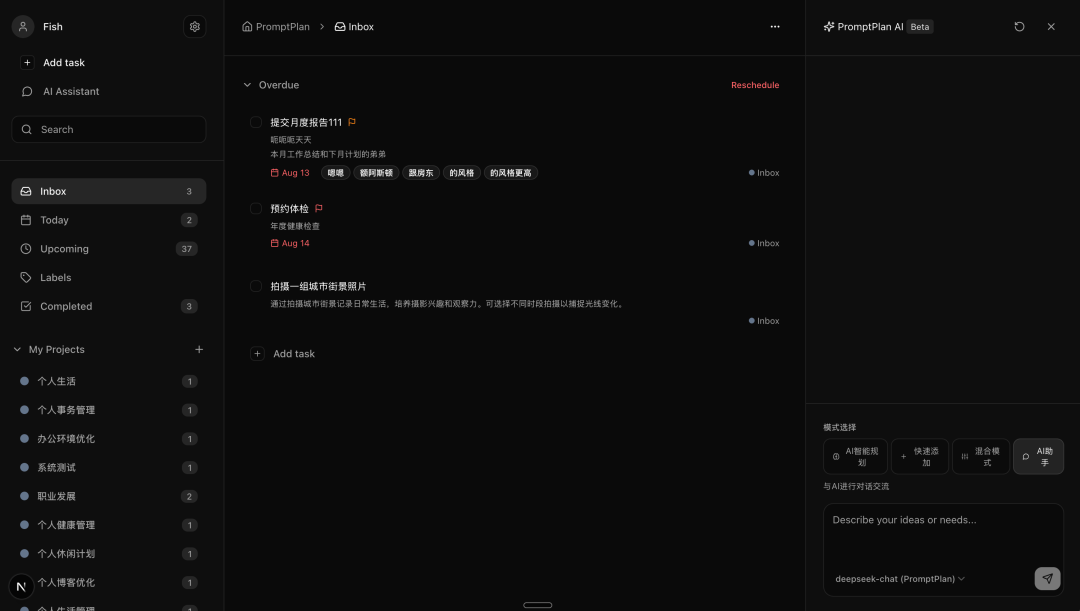
Some time ago, I made a decision to migrate the project to Next.js, abandoning the native approach. The issue with the native version was that the MCP and underlying CoreData data didn't work well together. When other AIs called PromptPlan's MCP, they encountered a bunch of main thread and sub-thread issues, as well as synchronization problems, leading to reading only cached data from CoreData, causing the interface to be out of sync.
I'm not a Swift expert and basically don't know how to write it. After chatting with GPT for a long time, I realized I didn't strongly depend on some local Mac operations. I researched some similar TODO products, which were mostly done in a web-wrapped format. I then decided to start the migration, but as I said, it hasn't gone very smoothly and should be postponed until next month for launch. By then, Windows, Mac, and Web should all be usable.
Others
Recently, I've been focusing my energy on a web3 project, which involves multiple ends (frontend, backend, data synchronization, contracts, etc.). This project, according to traditional development standards, would require an 8-person team working for three months, but now it's just one person and several AI tools. So I'm considering whether I can integrate my previous project management and product experience into this, and I'm still exploring. I've spent about a week adjusting documents daily, including requirements for various modules, technical solutions, test cases, etc., and starting to generate from writing test code. Since we haven't officially integrated yet, I don't know the specific effects.
The biggest problem I'm currently facing is context pollution. For example, if I change a requirement, related projects often get polluted by using the old requirement, resulting in more mistakes the more I change. I currently don't have a particularly good solution and can only rely on test coverage. However, smart AI will also modify the test code to achieve a high pass rate. So, I wrote nine honest coding rules for it, and I'm still observing how effective they are.
The quantification program has also been redone, but it hasn't been officially debugged yet. The old version has been modified into over 90 modules, but some bugs have been persistent and unresolved. This is also the biggest problem I'm facing right now: complex projects are very difficult to maintain, and if not carefully controlled, they can easily spiral out of control.